import numpy as np
from copy import copy
import bisect

def get_support(x):
   # returns the support of input vector x
   return list(np.where(x>0)[0])

def get_neg_support(x):
   # returns the support of input vector x
   return list(np.where(x<0)[0])

def activeset(y,W,x):
   # Initialize the support and restricted LS solutions
   supp = get_support(x)
   res = y - W@x
   print(f"Residual: {np.linalg.norm(y - W@x)}, support {supp}")

   # main AS loop, stop when the support does not change
   iter = 0
   old_supp = [-1]  #anything different than initial support
   while supp != old_supp:
      old_supp = copy(supp)
      iter += 1
      print(f"Iteration {iter}")
      # 1. Support update: find the "most negative" Lagrange multiplier
      if len(supp) < len(x):  # if the support is full do not update the support (only happens at init)
         dual_params = W.T@res
         dual_params[supp] = -np.inf # zero out the entries corresponding to the current support
         idx = np.argmax(dual_params)
         bisect.insort(supp, idx)  # insert support index while keeping sorted

      # 2. Unconstrained Least Squares restricted to the support
      ls_sol = np.linalg.lstsq(W[:,supp], y, rcond=None)[0]
      # embed ls_sol into full space
      ls_sol_full = np.zeros_like(x)
      ls_sol_full[supp] = ls_sol
      neg_supp = get_neg_support(ls_sol_full)

      # 3. Support iterative refinement, to ensure ls_sol is nonnegative
      while len(neg_supp) > 0:
         # Move along the line from previous to candidate estimate, until the cone is crossed
         t = np.min(x[neg_supp]/(x[neg_supp]-ls_sol_full[neg_supp]))
         # Update x to decrease the cost along the line (x, ls_sol-x), until the constraints are active
         x = x + t*(ls_sol_full - x)
         # Update the support (remove one element)
         supp = get_support(x)
         # Recompute LS solution on the new support and count negative entries
         ls_sol = np.linalg.lstsq(W[:,supp], y, rcond=None)[0]
         ls_sol_full = np.zeros_like(x)
         ls_sol_full[supp] = ls_sol
         neg_supp = get_neg_support(ls_sol_full)
         print(f"Residual: {np.linalg.norm(y - W@x)}, support {supp}, step {t}")

      # Update x with new nonnegative ls_sol
      x = ls_sol_full
      res = y - W@x

      # printing error for following AS progress
      print(f"Residual: {np.linalg.norm(res)}, support {supp}")

   return x, supp
np.random.seed(2)
m=6
n=50
W = np.random.rand(m,n)
support = [0,2,4]
xtrue = np.zeros(n)
xtrue[support] = np.random.rand(3)
y = W@xtrue + 0.1*np.random.randn(m)
x0 = np.zeros(n)
#x0 = np.random.rand(n)
x_opt, est_support = activeset(y,W,x0)
print("Optimal x:", x_opt)
print(f"Optimality criterion on estimated support: {np.linalg.norm(W[:,est_support].T@(y-W@x_opt))}")
print(f"Optimality criterion on true support: {np.linalg.norm(W[:,support].T@(y-W@x_opt))}")
Residual: 0.7332827438506135, support []
Iteration 1
Residual: 0.34036387671449636, support [np.int64(49)]
Iteration 2
Residual: 0.23756836129567335, support [np.int64(41), np.int64(49)]
Iteration 3
Residual: 0.16861002184543533, support [np.int64(7), np.int64(41), np.int64(49)]
Iteration 4
Residual: 0.15317817929560062, support [np.int64(3), np.int64(7), np.int64(41)], step 0.13149418992974335
Residual: 0.134132076527192, support [np.int64(3), np.int64(7), np.int64(41)]
Iteration 5
Residual: 0.10556301170510976, support [np.int64(3), np.int64(4), np.int64(7), np.int64(41)]
Iteration 6
Residual: 0.051953693458475836, support [np.int64(3), np.int64(4), np.int64(41), np.int64(44)], step 0.5419766926290853
Residual: 0.04449646221989812, support [np.int64(4), np.int64(41), np.int64(44)], step 0.48416969293682605
Residual: 0.04207535623520431, support [np.int64(4), np.int64(41), np.int64(44)]
Iteration 7
Residual: 0.04207535623520431, support [np.int64(4), np.int64(41), np.int64(44)], step 0.0
Residual: 0.04207535623520431, support [np.int64(4), np.int64(41), np.int64(44)]
Optimal x: [0.         0.         0.         0.         0.00500251 0.
 0.         0.         0.         0.         0.         0.
 0.         0.         0.         0.         0.         0.
 0.         0.         0.         0.         0.         0.
 0.         0.         0.         0.         0.         0.
 0.         0.         0.         0.         0.         0.
 0.         0.         0.         0.         0.         0.25668643
 0.         0.         0.45111056 0.         0.         0.
 0.         0.        ]
Optimality criterion on estimated support: 1.8019635810009614e-16
Optimality criterion on true support: 0.004015649566386405
import tensorly as tl
import numpy as np

def hals_nnls(
    UtM,
    UtU,
    V=None,
    n_iter_max=500,
    tol=1e-8,
    epsilon=0.0,
):
    rank, _ = tl.shape(UtM)
    if V is None:
        V = tl.solve(UtU, UtM)
        V = tl.clip(V, a_min=0, a_max=None)

    for iteration in range(n_iter_max):
        rec_error = 0
        for k in range(rank):
            if UtU[k, k]:
                num = UtM[k, :] - tl.dot(UtU[k, :], V) + UtU[k, k] * V[k, :]
                den = UtU[k, k]

                V[k,:] = tl.clip(num / den, a_min=epsilon)
                rec_error += tl.norm(V - V[k,:]) ** 2

        if iteration == 0:
            rec_error0 = rec_error
        if rec_error < tol * rec_error0:
            break

    return V
np.random.seed(2)
m=10
r = 6
n=20
W = np.random.rand(m,r)
Htrue = np.random.randn(r,n)
Htrue[Htrue<0] = 0  # sparsify true H
Y = W@Htrue + 0.01*np.random.randn(m, n)
errs = []
def callback_err(H):
   errs.append(np.linalg.norm(Y - W@H)/np.linalg.norm(Y))
   return True
Hest = hals_nnls(W.T@Y, W.T@W, n_iter_max=100, tol=1e-6, callback=callback)
print(f"Relative Reconstruction error: {np.linalg.norm(Y - W@Hest)/np.linalg.norm(Y)}")
print(f"Mean square error on H: {np.linalg.norm(Htrue - Hest)/r/n}")

plt.figure()
plt.semilogy(errs)
plt.xlabel("Iteration")
plt.ylabel("Relative Reconstruction Error")
plt.title("HALS NNLS with Callback Error Monitoring")
plt.grid()
plt.show()
---------------------------------------------------------------------------
NameError                                 Traceback (most recent call last)
Cell In[4], line 13
     11    errs.append(np.linalg.norm(Y - W@H)/np.linalg.norm(Y))
     12    return True
---> 13 Hest = hals_nnls(W.T@Y, W.T@W, n_iter_max=100, tol=1e-6, callback=callback)
     14 print(f"Relative Reconstruction error: {np.linalg.norm(Y - W@Hest)/np.linalg.norm(Y)}")
     15 print(f"Mean square error on H: {np.linalg.norm(Htrue - Hest)/r/n}")

NameError: name 'callback' is not defined
import tensorly as tl
import numpy as np
from tensorly.solvers import hals_nnls
from time import perf_counter

def BCD_hals(Y,Winit,Hinit,n_inner,n_outer):
    W = np.copy(Winit)
    H = np.copy(Hinit)
    #loss = [np.linalg.norm(Y - W@H.T,'fro')**2]
    #time = [0]
    start = perf_counter()
    loss = []
    time = []

    for it in range(n_outer):
        # Update H
        UtM = W.T @ Y
        UtU = W.T @ W
        H = hals_nnls(UtM, UtU, V=H.T, n_iter_max=n_inner, tol=0).T

        # Update W
        VtM = H.T @ Y.T
        VtV = H.T @ H
        W = hals_nnls(VtM, VtV, V=W.T, n_iter_max=n_inner, tol=0).T

        loss.append(np.linalg.norm(Y - W@H.T,'fro')**2)
        time.append(perf_counter() - start)
        #print(f"Iteration {it+1}, loss: {loss[-1]}, time: {time[-1]:.4f}s")
    return W, H, loss, time


# Generate toy synthetic nonnegative tensor data
np.random.seed(0)
shape = [2000, 50]
rank = 3
Wtrue, Htrue = [np.random.rand(s, rank) for s in shape]
Y = Wtrue @ Htrue.T
Winit = np.random.rand(shape[0], rank)
Hinit = np.random.rand(shape[1], rank)
results = {}

for n_inner in [1,2,3,5,10,20,100]:
    print(f"Running BCD-HALS with n_inner={n_inner}")
    West, Hest, loss, time_ = BCD_hals(Y, Winit=Winit, Hinit=Hinit, n_inner=n_inner, n_outer=800)
    results[n_inner] = (loss, time_)
Running BCD-HALS with n_inner=1
Running BCD-HALS with n_inner=2
Running BCD-HALS with n_inner=3
Running BCD-HALS with n_inner=5
Running BCD-HALS with n_inner=10
Running BCD-HALS with n_inner=20
Running BCD-HALS with n_inner=100
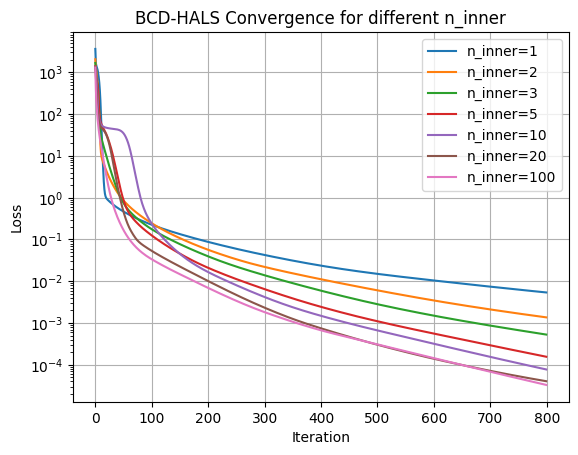
# Iteration plot
import matplotlib.pyplot as plt
plt.figure()
for n_inner, (loss, time_) in results.items():
    plt.semilogy(loss, label=f"n_inner={n_inner}")
plt.xlabel("Iteration")
plt.ylabel("Loss")
plt.title("BCD-HALS Convergence for different n_inner")
plt.legend()
plt.grid()
plt.show()

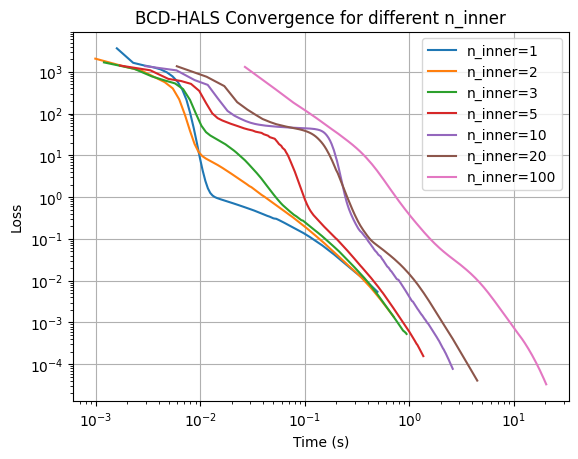
# Time plot
plt.figure()
for n_inner, (loss, time_) in results.items():
    plt.loglog(time_, loss, label=f"n_inner={n_inner}")
plt.xlabel("Time (s)")
plt.ylabel("Loss")
plt.title("BCD-HALS Convergence for different n_inner")
plt.legend()
plt.grid()
plt.show()